Why Southeast Asia Is Becoming the World’s Most Strategic BPO Destination
For two decades, the global outsourcing map had a few fixed capitals. But the map is being redrawn. Businesses choosing a BPO destination in 2026 are weighing more than hourly rates: language depth, time-zone strategy, digital infrastructure, data protection regimes, and resilience all matter. On that fuller scorecard, one region keeps rising to the top- Southeast Asia. Here is why, country by country and factor by factor.
The Regional Advantage: Five Markets, One Ecosystem
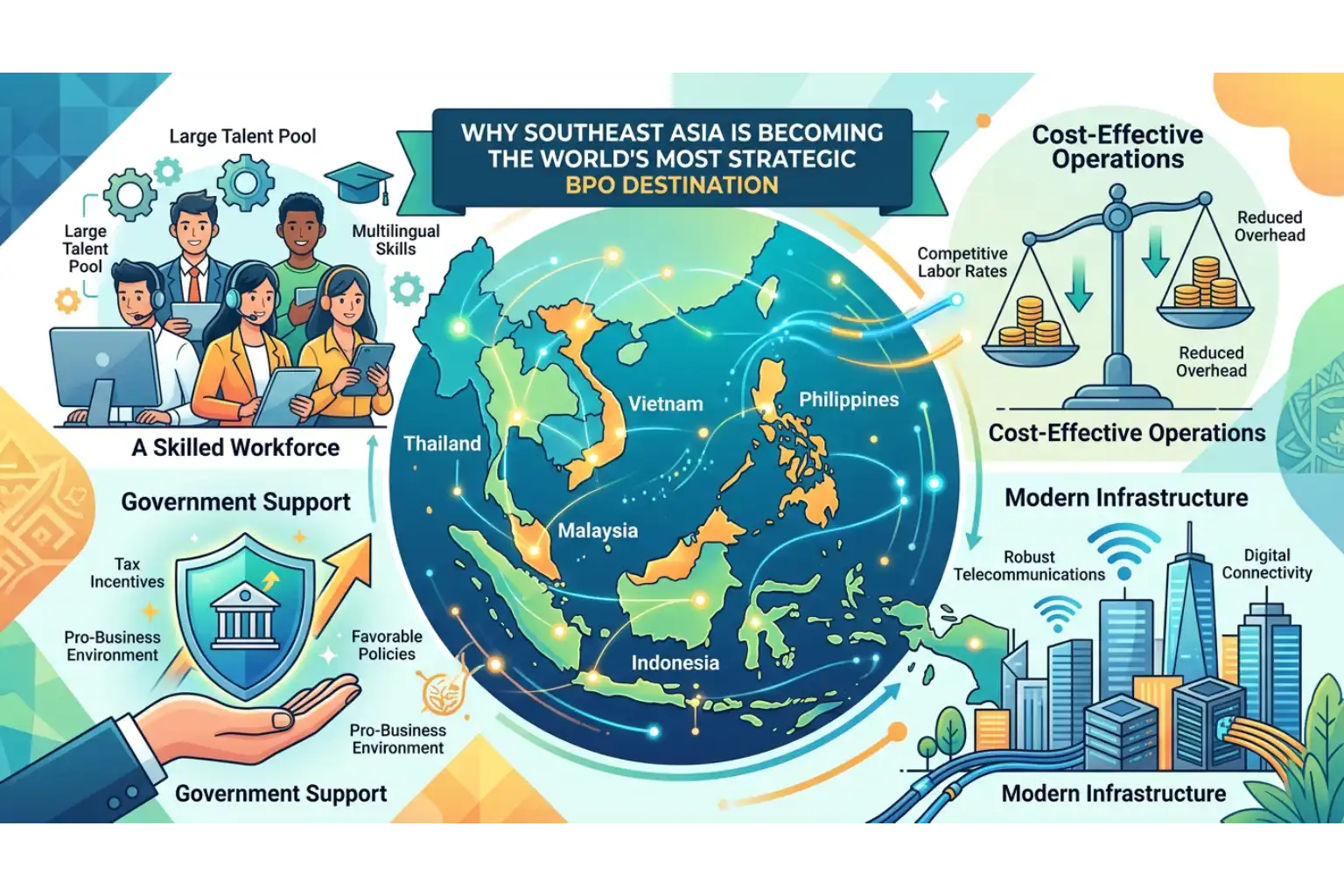
Southeast Asia’s outsourcing strength is not any single country- it is the portfolio. Singapore provides the governance layer: political stability, world-class connectivity, strong rule of law, and a data protection regime (the PDPA) that enterprise clients trust. Malaysia offers an exceptional multilingual talent pool at highly competitive cost. The Philippines brings the world’s most celebrated customer service culture and deep English fluency. Vietnam adds a fast-growing, technically strong workforce, and Indonesia contributes enormous scale and coverage of the world’s fourth-largest population.
A provider operating across all five- as Antasis does, headquartered in Singapore with delivery centres in Malaysia, the Philippines, Vietnam, and Indonesia- can architect a solution no single-country provider can match: Singapore-grade governance and client management, with delivery placed wherever language, cost, and coverage requirements are best served.
Factor 1: Language Depth That Follows Your Customers
Global CX increasingly means Asian CX. If your customers speak English, Mandarin, Malay, Bahasa Indonesia, Tagalog, or Vietnamese- and for businesses growing in APAC, they do- Southeast Asia is the only region where all of those languages are native to the delivery workforce. Malaysia in particular is a quiet multilingual powerhouse, where English, Malay, Mandarin, and Tamil coexist in daily commercial life. This is not a translated service; it is native-speaker support at scale.
Factor 2: The Time-Zone Sweet Spot
Sitting between GMT+7 and GMT+8, Southeast Asia overlaps Australian mornings, covers all of Asia in real time, catches European afternoons, and- paired with night-shift traditions well established in the Philippines- serves North American hours too. For a business promising follow-the-sun support, the region functions as a natural pivot point: one regional operation can credibly anchor 24/7 global coverage.
Factor 3: Cost Efficiency Without the Quality Trade-Off
Labour arbitrage started the outsourcing industry, and it still matters: delivery costs in Malaysia, the Philippines, Vietnam, and Indonesia remain dramatically lower than in Western markets, and meaningfully lower than in maturing hubs elsewhere. What has changed is the quality side of the equation. Decades of BPO operations have built deep professional talent pools, established training academies, and management layers with genuine industry experience. The result is a rare combination: emerging-market cost with mature-market process discipline- particularly when governed from Singapore.
Factor 4: Digital Infrastructure and the AI Layer
Southeast Asia’s digital economy has been growing at double-digit rates for years, pulling infrastructure investment with it: submarine cables, data centres, cloud regions from every major provider, and near-universal mobile-first consumer behaviour. For outsourcing, this means two things. First, delivery reliability- modern facilities, redundant connectivity, uptime guarantees. Second, AI-readiness: regional providers have moved quickly to blend conversational AI platforms, intelligent routing, and automated engagement tools with human teams, because the region’s own consumers already live on chat-first channels. Buyers now get a human-plus-AI operating model as the default, not a premium add-on.
Factor 5: Governance, Security, and Resilience
Enterprise buyers ask harder questions than they did a decade ago: Where does my data live? Which privacy law governs it? What happens if one site goes down? Southeast Asia answers well. Singapore’s PDPA provides a respected regulatory anchor, and regional providers increasingly hold recognised certifications for security and quality management. Just as importantly, a multi-country footprint is a built-in business continuity plan- if one location is disrupted by weather, outage, or local events, work reroutes to sister sites in neighbouring countries. Single-site providers simply cannot offer that.
What This Means for Different Buyers
- For SMEs in Singapore and Malaysia- nearshoring within the region means your outsourced team works your business hours, understands your market’s cultural context, and can be visited on a short flight- while still cutting cost dramatically versus local hiring.
- For Australian and East Asian businesses- the region offers same-day time-zone alignment that traditional offshore destinations cannot, eliminating the overnight lag in escalations and collaboration.
- For Western enterprises- Southeast Asia provides diversification- a second delivery region alongside existing arrangements, reducing concentration risk while adding Asian language coverage for APAC growth plans.
Choosing Within the Region
The practical question is rarely which country?- it is which mix? A sensible engagement might place multilingual voice support in Malaysia, English-heavy volume in the Philippines, back-office processing in Vietnam or Indonesia, and account governance in Singapore. This is exactly the kind of architecture to pressure-test when evaluating providers: ask where each function would sit and why, and listen for reasoning grounded in language, cost, and continuity rather than a one-site sales pitch.
The Talent Story Behind the Statistics
Infrastructure and cost explain why businesses look at Southeast Asia; talent explains why they stay. The region’s BPO workforce has professionalised dramatically over two decades. University systems across the five markets produce large cohorts of graduates in business, IT, and communications; the industry has built structured career ladders from agent to team lead to operations management; and a generation of managers now exists who have spent entire careers running outsourced operations to international standards. This management layer is the least visible and most valuable asset in the regional industry- process discipline, QA culture, and client-relationship maturity do not come from wage rates; they come from experienced people.
Cultural factors compound the advantage. Service orientation is deeply embedded in the region’s commercial culture, and the workforce’s daily fluency across languages and cultures- a Malaysian agent switching between English, Malay, and Mandarin within a single shift- produces a kind of contextual intelligence that no training programme can install. For customer experience work, where tone and cultural register decide whether an interaction feels caring or robotic, this native versatility is a structural moat.
Finally, the region’s demographics point the right way. Young, growing, digitally native populations mean the talent pipeline deepens rather than ages- a sharp contrast with delivery markets facing demographic contraction. Businesses choosing a BPO destination are choosing a twenty-year relationship with a labour market; Southeast Asia’s trajectory makes that bet unusually safe.
Government Support and Industry Maturity
One underappreciated factor separates Southeast Asia from many emerging delivery regions: sustained government backing. Across the five markets, national digital economy strategies, investment incentives, IT-park infrastructure, and workforce development programmes have treated the BPO and digital services sector as a strategic industry for over a decade. This support shows up in practical ways buyers feel directly- reliable power and connectivity in designated business zones, streamlined foreign-business frameworks, and training subsidies that keep the talent pipeline flowing. Industry associations in each market maintain standards, share benchmarks, and coordinate with regulators, giving the regional sector an institutional maturity that individual providers inherit. When you contract with an established Southeast Asian provider, you are plugging into that entire ecosystem- not just renting seats in an office.
Frequently Asked Questions
Which Southeast Asian country is best for BPO?
It depends on the function. The Philippines excels at English voice support, Malaysia at multilingual coverage, Vietnam and Indonesia at scalable back-office work, and Singapore at governance and enterprise account management. Multi-country providers combine these strengths in one engagement.
Is Southeast Asia more expensive than other offshore destinations?
Delivery costs are broadly competitive with other major outsourcing regions, and the total value equation- language range, time-zone fit for APAC, infrastructure quality, and multi-site resilience- frequently makes it the stronger overall buy.
Is my data safe with a Southeast Asian provider?
Reputable regional providers operate under frameworks such as Singapore’s PDPA, hold security and quality certifications, and implement encryption, access controls, and audit trails. As anywhere, verification of a specific provider’s certifications is an essential step in due diligence.
Can Southeast Asian teams support Western time zones?
Yes. Night-shift operations are a long-established norm in the regional industry, and multi-country footprints allow providers to construct genuine 24/7 follow-the-sun coverage.
How do I start outsourcing to Southeast Asia?
Begin with a discovery conversation covering your volumes, languages, hours, and systems. A capable provider will propose a pilot scope with defined service levels so you can validate quality before scaling.
Ready to get started? Antasis is a Singapore-headquartered BPO and CX provider with 20+ years of experience and delivery centres across Malaysia, the Philippines, Vietnam, and Indonesia- handling 10 million+ calls annually. Talk to us at antasis.com/contact-us about the right regional mix for your business. |