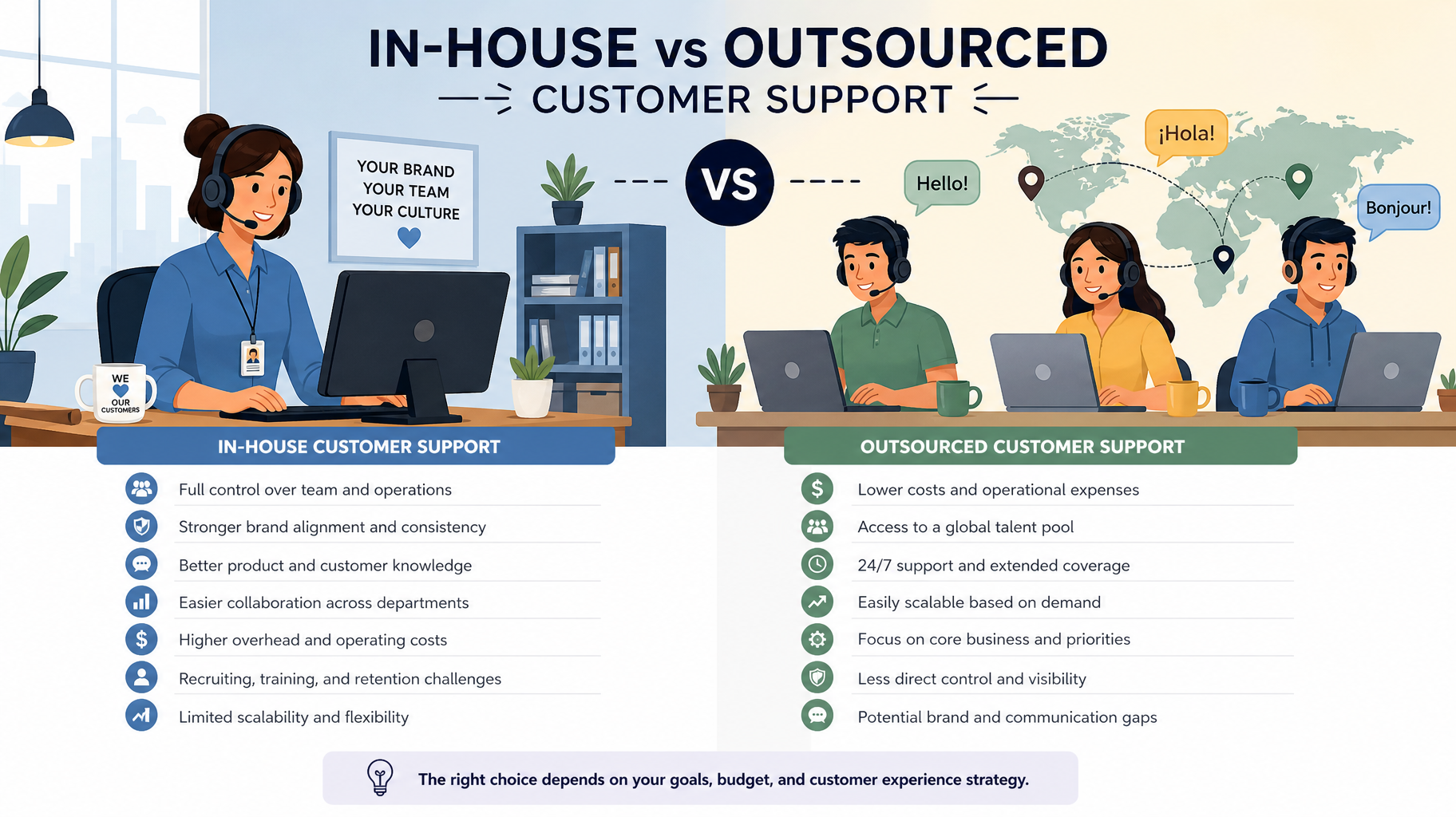
In-House vs Outsourced Customer Support: The Real Cost Comparison for 2026
Every cost comparison between in-house and outsourced customer support starts the same way: someone opens a spreadsheet, types in agent salaries on one side and a provider’s quote on the other, and declares a winner. And almost every one of those comparisons is wrong- because salary is rarely even half of what an in-house support seat actually costs. This article walks through the full cost stack on both sides, the hidden lines most businesses forget, and the situations where each model genuinely wins.
The Visible Cost: Salaries
Start with the obvious. An in-house customer support agent’s salary varies enormously by market- a support role in Singapore costs a multiple of the same role in Malaysia, the Philippines, Vietnam, or Indonesia. If your business is headquartered in a high-cost market, every seat you staff locally carries that premium, whether or not the work requires local presence.
Outsourced pricing compresses this into a simple number: a per-hour rate for shared coverage, or a per-seat monthly rate for dedicated agents. The provider absorbs local salary markets, currency movements, and statutory employment costs. What you see on the invoice is what you pay.
The Invisible Cost Stack of an In-House Team
Here is where most comparisons collapse. A realistic fully loaded cost model for an in-house support seat includes at least eight lines beyond base salary:
- Statutory costs and benefits- employer contributions, insurance, paid leave, and medical benefits typically add 15–25% on top of base salary depending on jurisdiction.
- Recruitment- agency fees, advertising, interview time, and onboarding admin. Support roles turn over fast, so this is a recurring cost, not a one-off.
- Training- a new support agent typically takes four to eight weeks to reach full productivity. During that ramp you pay full salary for partial output, plus the trainer’s time.
- Attrition- contact-centre attrition rates of 30–45% per year are common industry-wide. Every departure restarts the recruitment and training clock and quietly drains team knowledge.
- Management overhead- team leads, QA reviewers, and workforce planners. A common ratio is one supervisor per 8–12 agents- a cost line that scales with the team.
- Technology- telephony, ticketing, CRM licences, QA tools, knowledge base software, and headsets. Per-agent software stacks routinely run to significant monthly cost.
- Facilities- desk space, utilities, and equipment- or the stipends and security controls of a remote setup.
- Coverage inefficiency- the quietly brutal one. Customer demand is spiky; salaried shifts are flat. You either overstaff to cover peaks or understaff and burn customers during them. And if you promise support beyond office hours, night and weekend shifts carry premiums and accelerate burnout.
Industry analyses consistently find that the fully loaded cost of an in-house seat lands at 1.6 to 2.2 times base salary once these lines are counted. That is the honest number to put in the left-hand column of your spreadsheet.
What the Outsourced Price Includes
A professional BPO quote bundles nearly all of the above into one rate: recruitment, training, supervision, QA, telephony and ticketing platforms, facilities, and- crucially- coverage engineering. Because a provider pools demand across clients and operates across time zones, 24/7 availability stops being a staffing nightmare and becomes a standard line item. Multilingual coverage works the same way: instead of hiring a Mandarin speaker, a Malay speaker, and a Tagalog speaker for fractional workloads, you draw on a shared multilingual bench.
Two cost behaviours differ fundamentally. First, outsourced cost is variable: you can flex seats up for a product launch and back down afterwards, which is nearly impossible with employment contracts. Second, the ramp cost of scaling sits with the provider- their bench, their training pipeline, their problem.
A Worked Example
Consider a business needing five agents of coverage across extended hours. In-house, at a modest base salary, the fully loaded annual cost- applying a conservative 1.7x multiplier and adding a part-time supervisor- typically lands between two and three times the headline payroll figure. The same coverage purchased as dedicated outsourced seats, or as a blended per-hour arrangement that follows actual demand curves, commonly comes in 40–60% lower on a like-for-like coverage basis, with 24/7 availability included rather than priced as overtime.
The exact numbers move with your market and requirements- which is precisely why the right next step is a proper discovery conversation rather than a generic calculator. But the direction of the gap is remarkably consistent.
When In-House Genuinely Wins
This comparison should be honest in both directions. In-house support is the right call when support is your product- for instance, a premium service where deep product intimacy is the differentiator and volumes are low enough for a small expert team. It also wins where regulation requires specific data handling that an external partner cannot yet certify, or where support conversations feed so directly into product decisions that you want engineers listening to calls.
Even then, hybrid models are increasingly common: a small in-house tier for complex or strategic cases, with an outsourced partner absorbing volume, after-hours coverage, and overflow. You keep the intimacy; the partner keeps the pager.
The Cost Nobody Puts in the Spreadsheet: Bad Service
The most expensive support model is the understaffed one. Long wait times and unanswered emails do not show up as a cost line- they show up as churn, refunds, and one-star reviews. Research across the CX industry repeatedly links poor service experiences to customer defection, and acquiring a replacement customer costs several times more than retaining an existing one. When an outsourcing arrangement lifts answer rates and first-call resolution, it is not just cheaper per seat; it is quietly repairing revenue leakage that the in-house model was causing.
The Scaling Test: Where the Models Really Diverge
Static cost comparisons miss the dimension where the two models differ most: what happens when demand changes. Consider three common scenarios. A product launch doubles ticket volume for six weeks- in-house, you either burn out the existing team or hire temps who won’t be trained before the surge ends; outsourced, the provider flexes seats from their bench within days. Expansion into a new market adds a language requirement- in-house, that is a recruitment project measured in months; outsourced, it is a scope change measured in weeks. A downturn forces cost reduction- in-house, that means redundancies with all their financial and human cost; outsourced, it is a contract adjustment at the agreed notice period.
This asymmetry has a name in finance: operating leverage. In-house support converts revenue volatility into staffing crises; outsourced support converts it into invoice line changes. For businesses with seasonal patterns, launch-driven spikes, or uncertain growth trajectories, the flexibility premium alone can justify outsourcing before the per-seat arithmetic is even considered.
There is also a management-attention cost that never reaches the spreadsheet. An in-house support operation consumes leadership bandwidth- hiring decisions, performance issues, rota disputes, tooling projects. Under an outsourced model, that bandwidth is spent reviewing dashboards and setting direction. Founders who have run both models consistently report that the reclaimed attention, not the reclaimed cost, was the larger prize.
Frequently Asked Questions
How much cheaper is outsourced customer support?
On a fully loaded, like-for-like coverage basis, businesses commonly save 40–60% versus in-house teams in high-cost markets- driven by labour arbitrage, shared infrastructure, and the elimination of recruitment, training, and management overhead.
Will outsourced agents know my product well enough?
That depends on onboarding, not geography. Mature providers run structured knowledge transfer, maintain living knowledge bases, and use QA calibration with your team so accuracy is measured, not assumed.
What pricing models exist for outsourced support?
The three standard models are per-hour (best for fluctuating volumes), per-seat monthly (best for dedicated ongoing support), and custom enterprise pricing for high-volume or multi-service arrangements.
Can I start small before committing?
Yes- a pilot covering one channel or one time band (such as after-hours calls) is the standard low-risk entry. It generates real performance data before you expand the scope.
Does outsourcing mean my customers talk to robots?
No. AI tools handle routing and repetitive queries, but professional providers pair automation with trained human agents- the AI absorbs volume so humans can spend time on conversations that need judgement and empathy.
Ready to get started? Antasis provides 24/7 multilingual customer support from delivery centres across Singapore, Malaysia, the Philippines, Vietnam, and Indonesia, with transparent per-hour, per-seat, and custom pricing. Book a free consultation at antasis.com/contact-us and get a like-for-like cost model built on your actual volumes. |
Email | sales@antasis.com |
Singapore HQ | Blk 162 Bukit Merah Central #06-3545, Singapore 150162 |
Singapore | +65-6319-2620 |
Philippines | +63-920-619-1194 |
Malaysia | +60-7587-9041 |