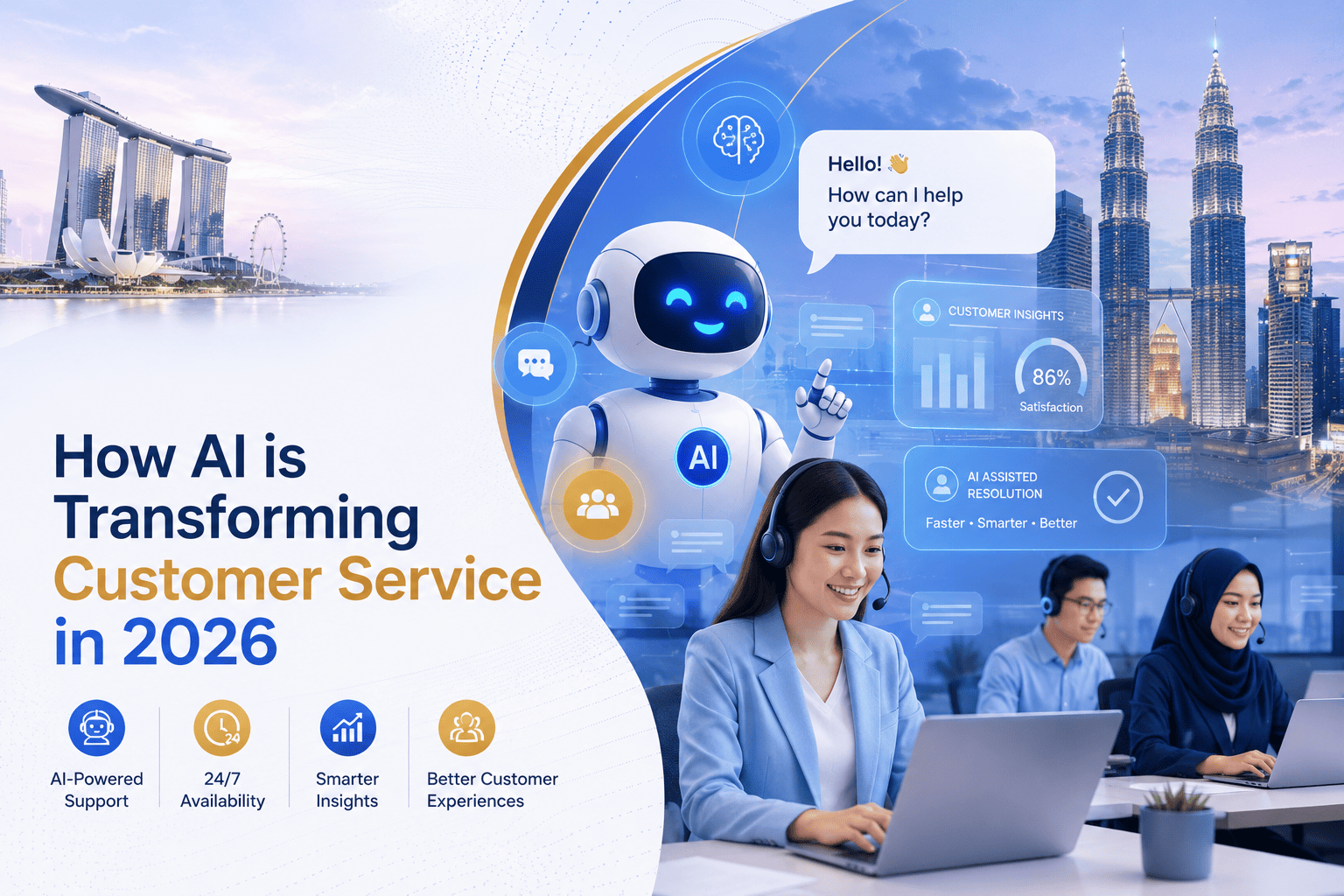
How AI Is Transforming Customer Service in 2026- Without Replacing the Human Touch
Every few months, a headline announces that AI is about to replace customer service teams. And every few months, businesses that believed the previous headline quietly rehire humans to clean up the mess. The truth emerging from the front lines in 2026 is more interesting than either extreme: AI is transforming customer service profoundly- but as an amplifier of human teams, not a replacement for them. This article maps what AI genuinely does well today, where humans remain irreplaceable, and how the best support operations are wiring the two together.
What AI Actually Does Well in Customer Service
Instant answers to repetitive questions
In most support operations, a large share of incoming queries cluster around a small set of topics: order status, password resets, opening hours, delivery windows, basic troubleshooting. Modern conversational AI resolves these instantly, in natural language, at any hour, in multiple languages. Customers get answers in seconds instead of queues; human agents get their time back for questions that deserve it.
Intelligent routing and triage
Before AI, routing meant phone menus- ‘press 2 for billing’- that customers navigated badly and resented. Intelligent interaction tools now read the intent, urgency, and even emotional tone of an incoming message and route it to the right destination: a knowledge-base answer, a specialist agent, or a priority escalation. Misrouted contacts drop; first-contact resolution climbs.
Agent assistance in real time
The least publicised, highest-impact use: AI working for the agent during the conversation. Live transcription, suggested responses, automatic retrieval of the relevant policy or order record, and post-call summaries that write themselves. Handle time falls, accuracy rises, and new agents perform like experienced ones far sooner.
Automated engagement and proactive service
AI also transforms outbound touches: order confirmations, delivery updates, appointment reminders, satisfaction check-ins, and win-back messages can be automated, personalised, and timed intelligently. The best proactive systems prevent inbound contacts altogether- the ticket that never needed to be raised is the cheapest ticket of all.
Where Humans Remain Irreplaceable
Everything above shares a property: the interaction is predictable. The moment a conversation involves ambiguity, emotion, judgement, or stakes, humans decisively outperform machines- and customers know it.
- Emotional situations- an angry customer, a bereaved family member closing an account, a patient anxious about an appointment. Empathy cannot be convincingly automated, and attempting it damages trust.
- Complex problem-solving- multi-system issues, exceptions to policy, situations nobody documented. Humans reason through novelty; AI retrieves precedent.
- Judgement calls- when to bend a rule, offer a goodwill gesture, or escalate to management. These decisions carry brand and financial consequences that businesses rightly keep in human hands.
- High-value relationships- B2B accounts and premium customers expect a person who knows their history. Relationship equity is built by people.
There is also a hard commercial fact: customers who are blocked from reaching a human when they need one churn. The ‘AI-only’ support model keeps being tried and keeps being rolled back- deflection that frustrates is not efficiency, it is deferred cost.
The Hybrid Model: How the Blend Actually Works
The operating model winning in 2026 is a layered one. AI forms the first layer, absorbing repetitive volume and running 24/7 triage. Human agents form the second, handling everything the first layer escalates- with AI now assisting them rather than replacing them. Supervisors and analysts form the third, using AI-generated analytics on every interaction to spot trends, coach agents, and feed product insight back to the business.
Two design principles separate good hybrids from bad ones. First, escalation must be effortless: the customer should never fight the bot to reach a person, and context must travel with them- nobody should repeat their story. Second, the division of labour must be measured: track resolution and satisfaction separately for AI-handled and human-handled contacts, and move the boundary based on evidence rather than cost hope.
What This Means for Businesses Evaluating Their Options
Building this stack in-house is a serious undertaking: platform selection, integration with CRM and ticketing, conversation design, ongoing tuning, and the human team around it. That is why AI has, counterintuitively, strengthened the case for outsourcing rather than weakened it. A provider that has already implemented conversational AI platforms, virtual agents, and intelligent routing across many clients delivers the hybrid model as a running system- with trained human teams attached- rather than a two-year internal project.
When evaluating providers, the discriminating questions are: which AI capabilities are live today (not roadmap)? How does escalation to humans work, and how fast? How are AI and human performance measured separately? And how does customer data flow through the AI layer- where is it processed, and under which privacy regime? Confident, specific answers to those four questions indicate a provider using AI to improve service. Vague ones indicate a provider using the word AI to improve margins.
The Numbers Businesses Are Seeing
Across the industry, well-implemented hybrid deployments consistently report the same pattern: large shares of routine queries resolved without human involvement, materially faster response times, meaningful reductions in cost per contact- and, crucially, customer satisfaction that rises rather than falls, because human agents now spend their time on the conversations where they add the most value. The e-commerce case is typical: pairing a 24/7 omnichannel human team with AI chat assistance has repeatedly been shown to lift satisfaction scores by double-digit percentages while cutting response times dramatically.
Implementation Realities: Why AI Projects Succeed or Stall
The gap between AI’s promise and its production reality usually comes down to unglamorous groundwork. Successful deployments share three foundations. First, knowledge quality: a conversational AI is only as good as the knowledge base behind it- outdated articles produce confident wrong answers, which damage trust faster than no answer at all. Auditing and restructuring knowledge content is properly the first phase of any AI support project, not an afterthought. Second, conversation design: mapping actual customer intents from historical ticket data, writing escalation logic for each, and defining the tone of voice- this design work, not the technology choice, determines whether the AI feels helpful or hostile. Third, tuning as an ongoing operation: reviewing failed conversations weekly, retraining on new intents, and expanding scope gradually from the highest-volume, lowest-risk query types outward.
This is also where the build-versus-partner decision becomes concrete. The technology is increasingly accessible; the operating discipline around it is not. A provider running AI-assisted support across dozens of clients has already made the early mistakes, built the tuning routines, and learned which query types automate safely- experience a first-time internal team must buy with its own customers’ patience. For most businesses, partnering compresses a year of learning into a month of onboarding.
Whichever path you choose, one governance rule is non-negotiable: measure AI performance with the same rigour as human performance. Containment rate alone is a vanity metric- a bot that deflects customers into giving up scores brilliantly on containment. Pair it with resolution verification, satisfaction on AI-handled contacts, and escalation-path completion, and the dashboard starts telling the truth.
Frequently Asked Questions
Will AI replace human customer service agents?
No- it is changing what they do. AI absorbs repetitive, predictable queries while humans handle complexity, emotion, and judgement. The overall need for skilled human agents in high-value conversations is rising, not falling.
What is a conversational AI platform?
A system that holds natural, context-aware conversations with customers across chat, voice, and messaging channels- understanding intent rather than matching keywords, and escalating smoothly to human agents when needed.
How is conversational AI different from a chatbot?
Traditional chatbots follow scripted decision trees and break on unexpected phrasing. Conversational AI understands intent, context, and sentiment, handles multi-turn conversations, and improves from interaction data.
Is AI customer service safe for regulated industries?
It can be, with the right controls: data encryption, regional processing, audit trails, and human review for sensitive decisions. Providers serving healthcare and finance should be able to explain their compliance architecture in detail.
How quickly can a business deploy AI-powered support?
Working with a provider that has pre-built platforms, initial deployments typically take weeks- starting with high-volume query types and expanding as the system learns your business.
Ready to get started? Antasis fuses human ingenuity with cutting-edge AI- conversational AI platforms, virtual customer service agents, intelligent interaction tools, and automated engagement, all backed by trained human teams across Southeast Asia. See what a hybrid support model would look like for your business at antasis.com/contact-us. |
Email | sales@antasis.com |
Singapore HQ | Blk 162 Bukit Merah Central #06-3545, Singapore 150162 |
Singapore | +65-6319-2620 |
Philippines | +63-920-619-1194 |
Malaysia | +60-7587-9041 |