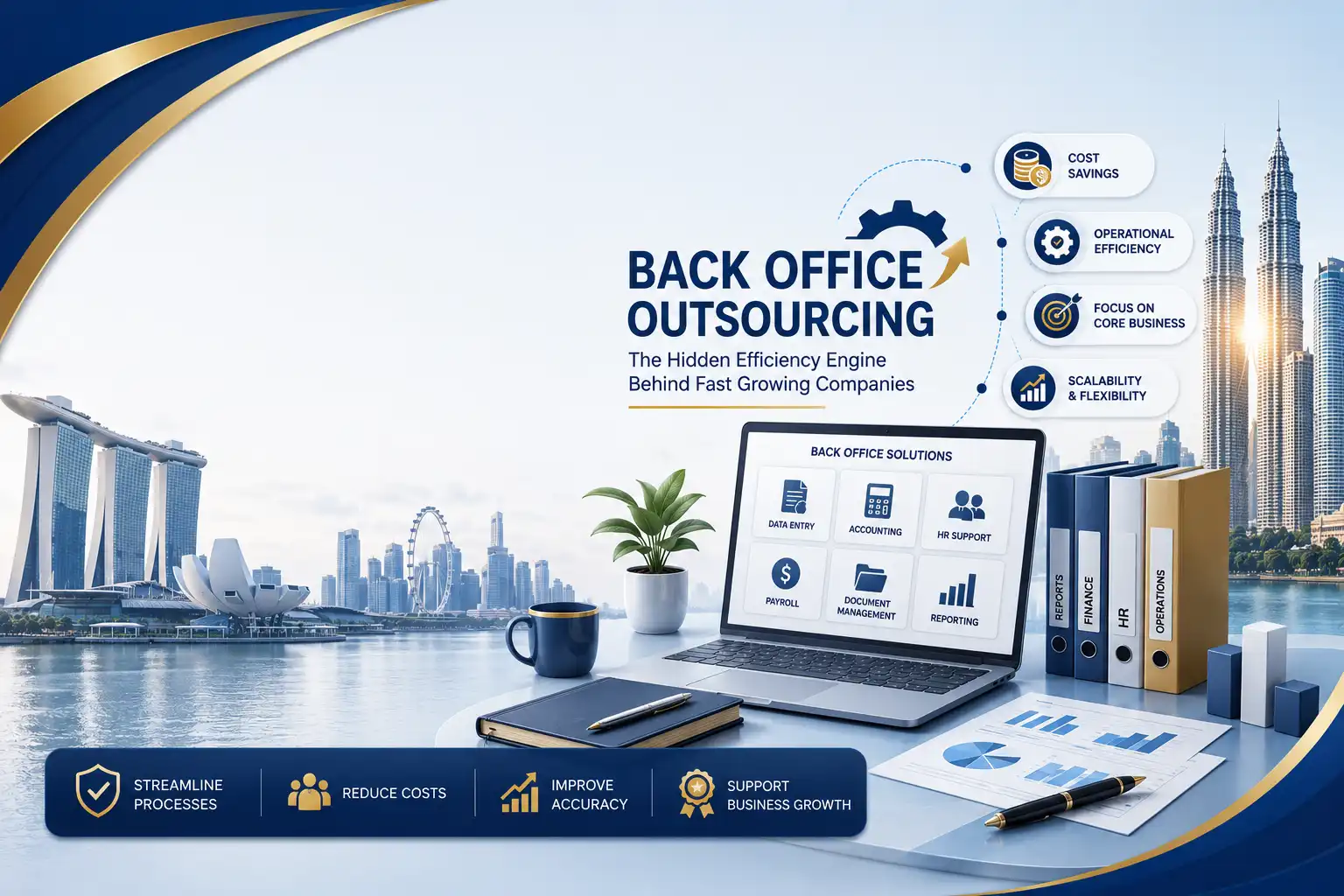
Back-Office Outsourcing: The Hidden Efficiency Engine Behind Fast-Growing Companies
Nobody starts a company to process invoices. Yet in most growing businesses, an astonishing share of skilled people’s time disappears into exactly that kind of work: keying data, moving documents, updating records, chasing confirmations, managing inboxes. It is invisible in the org chart and enormous in the payroll. Back-office outsourcing exists to reclaim that time – and while it gets less attention than customer-facing outsourcing, its returns are often faster and more certain. This guide covers what the back office actually includes, why it outsources so well, what the economics look like, and how to start without disruption.
What Counts as ‘Back Office’?
The back office is everything operationally essential that customers never see. In practice, four clusters dominate outsourcing engagements:
- Data entry and encoding – transferring information between formats and systems – digitising documents, updating databases, product catalogue maintenance, CRM record hygiene. Pure volume work where accuracy and turnaround are everything.
- Order and data processing – the transaction pipeline: order validation, entry, tracking, invoicing, returns processing, and reconciliation. Errors here touch customers directly – a mis-keyed order becomes a support ticket, a refund, and a bad review within the week.
- Email and document management – shared-inbox handling, document classification and filing, records organisation, and correspondence routing – the connective tissue that determines whether information flows or festers.
- Virtual assistant support – flexible administrative capacity for scheduling, research, data gathering, travel and calendar management, and the long tail of tasks that individually take minutes and collectively consume careers.
Why the Back Office Outsources So Well
Not all work transfers to an external team equally. Back-office processes score highly on every dimension that predicts outsourcing success. They are rule-based: most tasks follow documentable procedures with clear right answers, so quality can be defined and measured objectively – accuracy rates, turnaround times, throughput. They are volume-driven with fluctuating demand: month-end spikes, seasonal surges, and campaign bursts suit a flexible pool far better than fixed headcount. They rarely require real-time collaboration, so time-zone separation costs nothing – and can even help, with overnight processing returning finished work by morning. And they carry heavy opportunity cost in-house: every hour a manager, accountant, or salesperson spends on data hygiene is an hour of their actual job not being done.
There is also a quality paradox worth naming: specialist teams are usually more accurate than the in-house staff they relieve. For an operations executive, data entry is an interruption; for a dedicated processing team with double-key verification and QA sampling, it is the craft itself. Businesses regularly discover their error rates fall after outsourcing – the opposite of what they feared.
The Economics: Where the Savings Actually Come From
Back-office outsourcing savings arrive through three stacked mechanisms. The first is labour arbitrage – delivery from Southeast Asian centres costs a fraction of equivalent capacity in high-cost markets. The second is utilisation: you pay for productive throughput, not idle time between spikes, because the provider pools demand across clients. The third – the one spreadsheets miss – is reclaimed capacity: the sales team selling instead of updating the CRM, the finance team analysing instead of keying invoices. Combined, total cost reductions of 30–50% on the process are common, while the reclaimed internal hours generate value on top.
Pricing models mirror the work: per-transaction or per-record for well-defined volume processes, per-hour for variable assistant work, and per-seat monthly for dedicated ongoing capacity. Volume processes should always carry accuracy SLAs alongside turnaround SLAs – speed without accuracy is just fast rework.
The Automation Question
‘Shouldn’t we just automate this instead?’ Increasingly, the answer is: the good providers already have. Modern back-office outsourcing blends automation with human processing – OCR and intelligent document processing for extraction, RPA bots for repetitive system updates, and humans for exceptions, validation, and everything the automation cannot confidently handle. Buying the outcome from a provider gets you this blended model without building it: you pay for processed orders and accurate records, and the provider’s mix of bots and people is their problem to optimise. What matters contractually is the outcome SLA – accuracy, turnaround, throughput – not the method.
How to Start Without Breaking Anything
Back-office transitions fail in predictable ways, which makes them easy to avoid. The sequence that works:
- Document before you delegate – if a process lives only in someone’s head, write it down first – or have the provider’s transition team do the documentation as step one. Undocumented processes transfer badly and get blamed on the provider.
- Start with one bounded process – pick a well-defined, high-volume, low-ambiguity workflow – catalogue updates, invoice entry, a shared inbox. Prove accuracy and turnaround there before expanding.
- Run parallel briefly – for critical processes, have the provider shadow-process alongside your team for a short period, comparing outputs, before cutover.
- Define exception paths – the process will meet cases the documentation didn’t anticipate. Agree in advance how exceptions get flagged, who decides, and how the decision feeds back into the procedure.
- Measure from day one – accuracy sampling, turnaround tracking, and a weekly review during the first quarter. Early metrics build the trust that lets you delegate more.
Security and Confidentiality
Back-office work routinely touches sensitive data – customer records, financial documents, employee information – so provider security is non-negotiable. The baseline checklist: recognised security certifications, data processing agreements aligned to the privacy laws governing your customers (such as Singapore’s PDPA), role-based access controls with audit logging, secure facilities and endpoints, and clear data residency answers. A professional provider volunteers this architecture; treat any reluctance as disqualifying.
A Worked Example: The Order-Processing Turnaround
Abstract percentages become clearer through a typical engagement shape. Picture a growing e-commerce business processing a few hundred orders daily across a web store and two marketplaces. Orders arrive in three formats; a two-person operations team keys them into the fulfilment system, reconciles payments, processes returns, and updates tracking – falling behind every promotional weekend, with error rates nobody measures but everybody feels through support tickets that begin ‘where is my order?’.
The outsourced redesign follows a standard pattern. The provider’s transition team documents the three intake formats and the exception cases (address mismatches, payment holds, split shipments). Automation handles the clean majority: structured marketplace orders flow through validation rules without human touch. A dedicated processing team handles the exceptions and the unstructured remainder, working to a same-day turnaround SLA with double-key verification on payment-sensitive fields. Returns get their own documented workflow with a 24-hour processing commitment. Daily reconciliation reports replace the month-end surprise.
The results profile is consistent across such engagements: processing turnaround drops from next-day-if-lucky to same-day guaranteed; measured accuracy climbs above 99%; ‘where is my order?’ tickets fall because tracking updates go out on time; the two-person operations team redeploys to supplier management and inventory planning – work that grows the business rather than feeding the queue; and promotional weekends become a volume forecast sent to the provider rather than a staffing crisis. None of this is exotic. It is the ordinary, repeatable mechanics of giving rule-based volume work to a team built for it – which is precisely the point.
Frequently Asked Questions
What back-office functions are most commonly outsourced?
Data entry and encoding, order and data processing, email and document management, and virtual assistant support are the most common starting points – high-volume, rule-based work with measurable quality.
How much does back-office outsourcing save?
Total process cost reductions of 30–50% are typical, driven by labour arbitrage, pooled utilisation, and eliminated overhead – before counting the value of internal time reclaimed for core work.
How is quality controlled in outsourced data work?
Through accuracy SLAs, double-key verification on critical fields, QA sampling, and turnaround commitments – with reporting that makes accuracy verifiable rather than assumed.
Is it better to automate or outsource back-office work?
They are no longer alternatives. Mature providers deliver a blend of automation and human processing behind an outcome-based SLA – you contract for accurate, on-time results and the provider optimises the method.
How quickly can back-office outsourcing start?
For a documented process, transition typically takes two to six weeks including knowledge transfer, access setup, and parallel running. Undocumented processes add time up front – which is itself valuable documentation you currently lack.
Ready to get started? Antasis runs back-office and administrative services – data entry and encoding, order and data processing, email and document management, and virtual assistant support – with accuracy SLAs and 20+ years of process discipline. Reclaim your team’s time at antasis.com/contact-us. |
Contact Antasis
Ready to explore how outsourcing can work for your business? Reach the Antasis team directly:
Email | sales@antasis.com |
Singapore HQ | Blk 162 Bukit Merah Central #06-3545, Singapore 150162 |
Singapore | +65-6319-2620 |
Philippines | +63-920-619-1194 |
Malaysia | +60-7587-9041 |