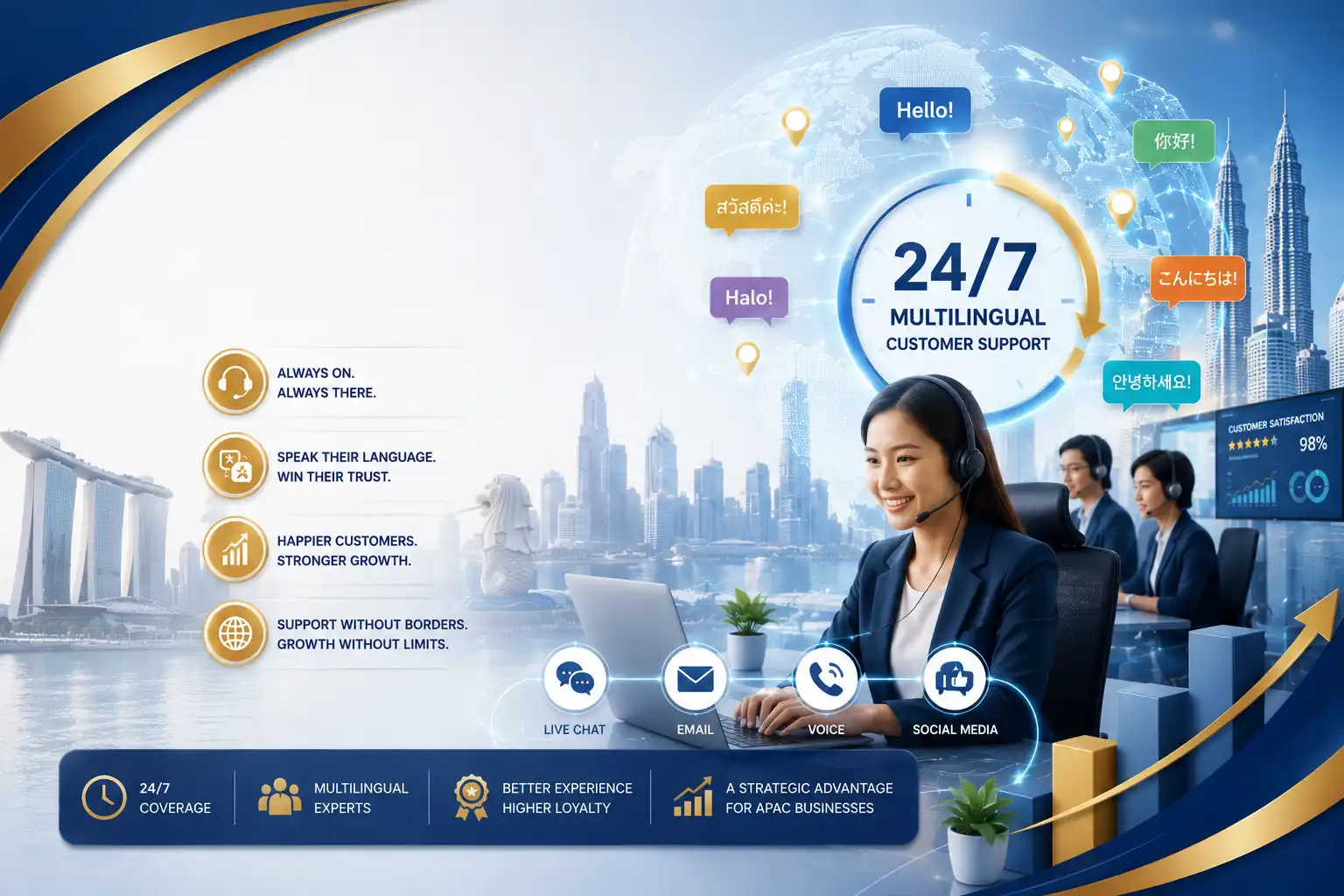
24/7 Multilingual Customer Support: The Growth Lever APAC Businesses Keep Underestimating
There is a moment in every growing company’s life when the support model built for one market quietly breaks. Perhaps a promising Indonesian customer emails in Bahasa and gets an English template back. Perhaps a Singaporean buyer calls at 9 p.m. and hits voicemail. Nothing dramatic happens – no complaint, no escalation. The customer simply doesn’t come back. This is the invisible tax of monolingual, office-hours support in a region that is multilingual and always on. This article makes the business case for 24/7 multilingual support in APAC, and shows why it has become dramatically more affordable than most leaders assume.
The APAC Reality: Many Languages, Many Time Zones, One Expectation
Asia-Pacific is not a market; it is dozens of markets wearing one acronym. Between Singapore, Malaysia, Indonesia, the Philippines, Vietnam, and the Chinese-speaking world, a regional business plausibly serves customers in English, Malay, Bahasa Indonesia, Mandarin, Tagalog, and Vietnamese – before counting Cantonese, Tamil, Thai, or Japanese. Meanwhile the region’s consumers are among the most mobile-first and chat-native on earth, with service expectations shaped by super-apps where replies arrive in minutes at midnight.
Two expectations follow. First, customers expect to be served in their language – not translated at, but understood, with the cultural fluency that native speakers carry. Second, they expect responses on their schedule, which across a region spanning multiple time zones (and customers who shop at night) effectively means always. Businesses that meet both expectations convert and retain measurably better; businesses that miss either leak revenue silently.
Language as a Revenue Variable, Not a Cost Line
Language support is usually budgeted as a cost, but it behaves like a conversion lever. Consumer research has repeatedly found that a large majority of buyers prefer purchasing in their own language and that many will not buy at all from businesses that cannot serve them in it. Post-purchase, the effect intensifies: a customer with a delivery problem or billing question who cannot resolve it in a language they’re comfortable in doesn’t persist heroically – they refund, churn, and review accordingly.
The commercial logic is straightforward. If native-language support lifts conversion and retention in a market even modestly, and that market represents meaningful revenue, the support investment pays for itself in retained customers – before counting the acquisition cost saved on customers who never had to be replaced.
The 24/7 Question: What After-Hours Silence Actually Costs
Round-the-clock coverage sounds like a luxury until you audit what happens outside business hours. For an e-commerce business, evenings and weekends are peak buying time – precisely when pre-purchase questions (‘does this ship to Penang?’) go unanswered and carts get abandoned. For SaaS and IT businesses, a system issue at 11 p.m. left until 9 a.m. is ten hours of customer anger compounding. For healthcare-adjacent services, appointment queries and anxious patients do not respect office hours at all.
In-house, 24/7 coverage is genuinely expensive: night-shift premiums, weekend rotas, supervisor coverage, and burnout-driven attrition. This is the economics that stops most SMEs. But the in-house cost structure is not the only one available.
How Outsourcing Rewrites the Economics
A regional BPO provider changes both hard problems at once. The multilingual problem is solved structurally: delivery centres across Southeast Asia sit inside the language pools themselves. A centre in Malaysia fields native English, Malay, and Mandarin; the Philippines contributes world-class English and Tagalog; Vietnam and Indonesia cover their home markets natively. Instead of hiring six language specialists for fractional workloads, you draw on a shared multilingual bench sized to actual demand.
The 24/7 problem is solved by pooling: because a provider serves many clients across many time zones, overnight staffing is a standing operation rather than a special effort. Your after-hours coverage becomes an allocation of an existing night shift, priced accordingly – often via per-hour models where you pay for coverage consumed rather than seats idling. Layer intelligent IVR and conversational AI on top for triage and instant answers to routine queries, and the overnight human team handles only what genuinely needs judgement.
Designing the Right Coverage Model
Full 24/7 across every channel and language from day one is rarely the right first step. A staged design works better:
- Stage one – extend hours where the leakage is – audit inbound contact attempts by hour and language. Cover the two or three windows and languages where missed contacts cluster. This alone typically captures most of the value.
- Stage two – add channels deliberately – voice and live chat for urgency, email and messaging for asynchronous queries, with AI-assisted triage across all of them so nothing waits unseen.
- Stage three – go always-on – once volumes justify it, close the remaining gaps to genuine 24/7/365 coverage – with SLAs that hold overnight performance to the same standard as daytime.
At every stage, insist on unified reporting: response times, resolution rates, and satisfaction sliced by language and time band. Coverage you cannot measure is coverage you cannot trust.
What Good Looks Like
A well-built multilingual 24/7 operation is nearly invisible from the customer’s side: the Jakarta customer chats in Bahasa at midnight and gets a fluent answer in minutes; the Singapore buyer calls on Sunday and reaches a human who resolves the issue on first contact; the Manila user’s technical ticket raised at 2 a.m. is triaged, prioritised, and answered before breakfast. Internally, the dashboard shows one consistent service standard across every hour and language – and the leadership team stops thinking about time zones entirely. That is the real deliverable: growth across a fragmented region, supported as if it were one market.
Beyond Translation: What Cultural Fluency Adds
Language coverage is the visible half of multilingual support; cultural fluency is the half that decides outcomes. The same sentence lands differently across markets: directness that reads as efficient in one culture reads as brusque in another; the expected rituals of greeting, apology, and escalation differ; even channel preferences diverge, with some markets living on messaging apps while others still trust voice calls for anything serious. Native-speaker agents carry this context automatically – they hear not just what the customer said, but what the customer meant, and they calibrate register without a style guide.
This fluency has measurable commercial consequences. Complaint de-escalation succeeds more often when the agent recognises culturally specific expressions of frustration and responds in the expected register. Upsell and retention conversations convert better when timing and phrasing match local norms. And in markets where relationships drive commerce, the accumulated goodwill of consistently being understood becomes brand equity – the kind competitors cannot copy with a translation plugin.
For businesses building an APAC support strategy, the practical implication is to evaluate providers on cultural depth, not language checklists. Ask where agents for each language are physically located and whether they are native speakers serving their home market. Ask how tone-of-voice guidance is localised per market rather than translated from a master document. And ask for satisfaction scores segmented by language – a provider proud of its multilingual operation will have that data ready, and a provider who cannot produce it is telling you the languages are a brochure feature.
Frequently Asked Questions
Is 24/7 support worth it for a small business?
It depends where your customers are and when they contact you. Audit missed contacts by hour first; many SMEs find that extending coverage into evenings and weekends via a shared outsourced team captures most of the value at a fraction of full 24/7 cost.
Which languages matter most for Southeast Asian markets?
English, Mandarin, Malay, Bahasa Indonesia, Tagalog, and Vietnamese cover the region’s major markets. The right mix depends on your customer base – contact data by language should drive the decision.
Isn’t machine translation good enough for support?
For internal triage, it helps. For customer-facing service, native fluency still wins decisively – cultural context, tone, and trust don’t translate mechanically, and customers can tell.
How is after-hours outsourced support priced?
Commonly per-hour for shared coverage of defined windows, or per-seat for dedicated overnight teams. Pooled models mean you pay for the coverage you use rather than full night-shift payroll.
How quickly can multilingual coverage launch?
With a provider that already staffs the languages natively, initial coverage typically launches within weeks – knowledge transfer and systems access, not recruitment, set the timeline.
Ready to get started? Antasis provides 24/7 multilingual support across English, Mandarin, Malay, Bahasa Indonesia, Tagalog, and Vietnamese from delivery centres in five Southeast Asian countries – handling 10 million+ calls a year. Map your coverage gaps with us at antasis.com/contact-us. |
Contact Antasis
Ready to explore how outsourcing can work for your business? Reach the Antasis team directly:
Email | sales@antasis.com |
Singapore HQ | Blk 162 Bukit Merah Central #06-3545, Singapore 150162 |
Singapore | +65-6319-2620 |
Philippines | +63-920-619-1194 |
Malaysia | +60-7587-9041 |