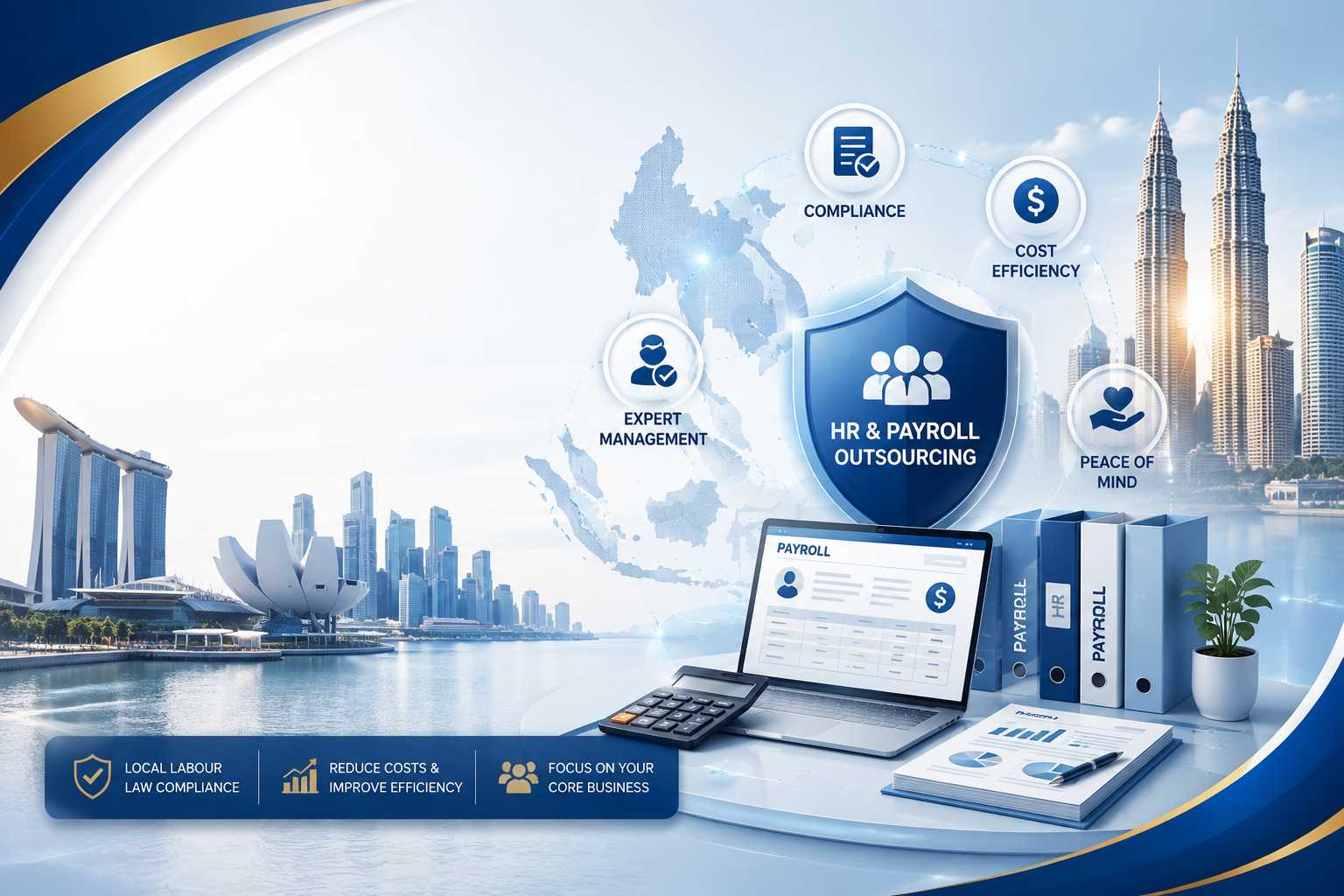
HR and Payroll Outsourcing in Southeast Asia: Compliance, Cost, and Peace of Mind
Payroll is the one business process with a 100% visibility rate: get it right and nobody notices; get it wrong once and every employee notices by lunchtime. Now multiply that stakes-to-glamour ratio across several Southeast Asian countries – each with its own statutory contributions, tax tables, leave rules, and filing calendars – and you have the function that quietly consumes more founder and finance-team anxiety per dollar than any other. This is why HR and payroll outsourcing has become one of the fastest-growing BPO categories in the region. Here is how it works, what it solves, and how to choose a provider you can trust with the most sensitive process you run.
Why Payroll Is Harder Than It Looks – Especially in SEA
On the surface, payroll is arithmetic: hours and salaries in, net pay out. In practice, the arithmetic sits inside a thicket of jurisdiction-specific rules. Every country in the region runs its own statutory contribution schemes with their own rates, caps, and employer/employee splits; its own income tax withholding logic; its own rules on overtime, leave encashment, bonuses, and termination pay; and its own filing deadlines with its own penalties. The rules also change – rates are revised, thresholds move, new levies appear – and the obligation to keep up sits entirely with the employer.
For a business operating in one country, this is a manageable burden that still regularly produces errors. For a business operating across two or more – a Singapore company with a Malaysian team, a regional business spanning four markets – in-house payroll means maintaining parallel expertise in multiple regulatory systems simultaneously. That is precisely the kind of specialised, rule-intensive, unforgiving work that outsourcing was invented for.
What HR & Payroll Outsourcing Actually Covers
Payroll processing and administration
The core service: gross-to-net calculation for every employee, statutory contribution computation and remittance, tax withholding and filings, payslip generation and distribution, disbursement coordination, year-end reporting, and the audit trail behind all of it. A capable provider owns the regulatory watch – when a contribution rate changes, your payroll changes with it, without your finance team reading gazette notices.
HR administration and support
Around the payroll core sits the administrative layer: employee records management, onboarding and offboarding administration, leave and attendance tracking, benefits administration, employment documentation, and HR helpdesk support for the everyday questions – ‘how much leave do I have?’, ‘when is my claim paid?’ – that otherwise interrupt whoever sits nearest to the HR folder. Outsourcing this layer gives smaller businesses something they otherwise cannot afford: a professional HR function without a full HR department.
The Business Case, in Four Parts
- Compliance risk transfer – the strongest single argument. Statutory errors carry penalties, back-payments, and reputational damage with regulators and employees. A specialist provider processes these rules daily across many clients – their error rate on rules they touch constantly is structurally lower than an in-house generalist’s on rules they touch monthly.
- Cost – the fully loaded cost of in-house payroll – specialist salary or fractional finance time, software licences, training, and error remediation – typically exceeds outsourced per-employee pricing significantly, and the gap widens with every additional country.
- Continuity – in-house payroll often depends on one person. Their leave, illness, or resignation becomes a payroll emergency. A provider’s bench removes the single point of failure from the process employees most depend on.
- Data security – salary data is among the most sensitive information a business holds. Professional providers bring encryption, role-based access, audit logging, and privacy-law compliance that most SMEs cannot replicate on a shared spreadsheet – which is, uncomfortably often, the in-house alternative.
Multi-Country Payroll: The Regional Advantage
For businesses operating across Southeast Asia, the provider’s footprint matters as much as its process. A regional provider with operations in Singapore, Malaysia, the Philippines, Vietnam, and Indonesia can run payroll in each market with local statutory expertise while giving you one contract, one point of contact, one consolidated reporting view, and one consistent service standard. The alternative – a separate local payroll vendor in every country – multiplies contracts, formats, and coordination overhead, and guarantees that no one sees your regional picture whole.
This structure also smooths expansion: entering a new market becomes a scope addition with an existing partner rather than a vendor search in an unfamiliar regulatory landscape.
Choosing a Provider: What to Verify
Payroll due diligence has its own checklist beyond generic BPO selection. Verify local statutory expertise in every country you need – ask how regulatory changes are tracked and implemented, and how clients are notified. Examine the accuracy commitment: what error rate does the SLA guarantee, how are errors classified, and what is the correction turnaround? Inspect the calendar discipline: cutoff dates, processing timelines, and what happens when a cutoff is missed on either side. Probe data security specifically – where payroll data is stored, who can access it, and which privacy regimes apply. And ask about the transition plan: parallel runs against your current payroll for one or two cycles before cutover are the professional standard, not an optional extra.
Finally, test the helpdesk. Your employees will have questions about their payslips; whether those questions are answered promptly and clearly will shape how the whole arrangement is perceived internally. A payroll provider with a responsive employee-facing support channel is worth a premium.
What Staying In-House Should Look Like
Outsourcing is not mandatory, and the honest comparison helps either way. If payroll stays in-house, it should have: documented procedures that survive personnel changes, at least two trained operators, current software with statutory updates maintained, a compliance calendar with named owners, access controls on salary data, and periodic external review. If reading that list produced a wince, the process is running on luck – and payroll is a bad place to store luck.
The Employee Experience Dimension
Payroll outsourcing discussions dwell on compliance and cost, but the constituency that feels the change most is your employees – and their experience deserves design attention. Done well, outsourcing upgrades the employee experience visibly: payslips arrive on time every cycle without exception; a proper helpdesk answers ‘why is my deduction different this month?’ with a clear explanation instead of ‘ask finance when they’re free’; leave balances live in a self-service portal rather than a spreadsheet someone updates eventually; and claims are processed on a published schedule employees can rely on. Reliability in these small, recurring moments builds more workplace trust than most engagement initiatives.
Done carelessly, the same transition creates anxiety. Employees hearing ‘payroll is being outsourced’ reasonably wonder who now sees their salary data and whether payday is about to become unreliable. The remedies are communication and proof: announce the change with its employee-facing benefits, name the data protections in plain language, and ensure the first two or three cycles are flawless – which is exactly what parallel running exists to guarantee. HR leaders who treat the transition as an internal product launch, complete with FAQs and a feedback channel, consistently report smooth adoption.
There is a strategic postscript for HR itself. Removing payroll administration from the HR team’s week does not shrink HR’s role; it refocuses it. Time recovered from calculations and filings flows into the work that actually needs human judgement – hiring, development, culture, and retention. The most compelling case for HR and payroll outsourcing, beyond risk and cost, is that it lets your HR people do human resources instead of arithmetic.
Frequently Asked Questions
What does payroll outsourcing include?
Gross-to-net salary calculation, statutory contributions and tax withholding, filings and remittances, payslip generation, disbursement coordination, year-end reporting, and audit trails – plus regulatory monitoring so rule changes are implemented automatically.
Is payroll outsourcing suitable for small businesses?
Yes – arguably most valuable there. Small businesses gain specialist compliance accuracy, continuity beyond a single key person, and professional data security at a per-employee cost far below a dedicated hire.
How secure is employee data with an outsourced payroll provider?
Reputable providers use encryption, role-based access controls, audit logging, and compliance with applicable privacy laws. Verify certifications and data residency during selection – professional providers volunteer this information readily.
Can one provider handle payroll across multiple SEA countries?
Yes. Regional providers with local operations in each market combine country-specific statutory expertise with a single contract, consolidated reporting, and one consistent service standard – dramatically simpler than managing separate local vendors.
How long does transitioning payroll to a provider take?
Typically one to two months including data migration, configuration, and one or two parallel runs alongside your existing payroll to verify accuracy before cutover.
Ready to get started? Antasis delivers HR support and payroll processing across Singapore, Malaysia, the Philippines, Vietnam, and Indonesia – local statutory expertise, one regional partner, and the data security your salary information deserves. Take payroll off your worry list at antasis.com/contact-us. |
Contact Antasis
Ready to explore how outsourcing can work for your business? Reach the Antasis team directly:
Email | sales@antasis.com |
Singapore HQ | Blk 162 Bukit Merah Central #06-3545, Singapore 150162 |
Singapore | +65-6319-2620 |
Philippines | +63-920-619-1194 |
Malaysia | +60-7587-9041 |