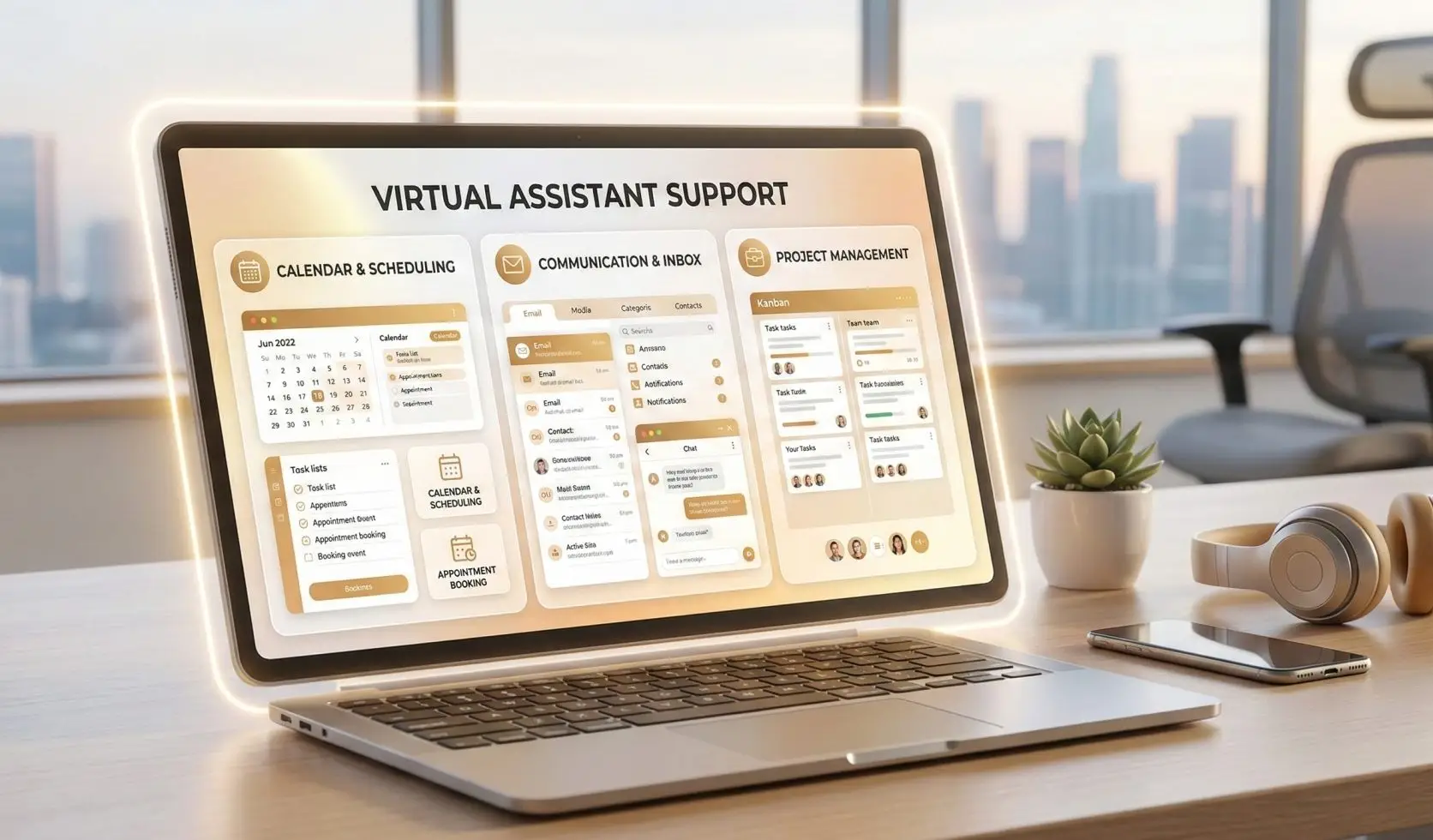
Virtual Assistant Support: 7 Smarter Ways to Scale Productivity Without Adding Headcount
What Is Virtual Assistant Support?
Virtual Assistant Support refers to professional, remote assistance that helps organizations manage administrative, operational, and data-driven tasks without hiring full-time, in-house staff. These assistants operate through secure digital systems and follow structured workflows aligned with business processes.
Unlike generic outsourcing, enterprise-level virtual assistant support focuses on accuracy, compliance, scalability, and integration with internal systems. Tasks are executed under defined controls, service-level agreements, and quality benchmarks.
As organizations face rising workloads and talent shortages, virtual assistant support has become a strategic solution rather than a temporary fix.
Why Businesses Are Adopting Virtual Assistant Support
Modern teams are overwhelmed with repetitive, time-consuming tasks that distract from high-value work. Administrative overload leads to burnout, delays, and inefficiencies.
Virtual Assistant Support helps organizations:
- Free internal teams from routine tasks
- Improve turnaround times
- Reduce operational costs
- Scale without increasing fixed headcount
- Maintain business continuity
When implemented correctly, it becomes an extension of the organization not an external dependency.
How Virtual Assistant Support Works in an Enterprise Environment
Virtual assistants operate within defined scopes and secure environments. Tasks are assigned through workflow tools or integrated systems, ensuring visibility and accountability.
Typical operational flow includes:
- Task definition and process documentation
- Secure system access and role-based permissions
- Execution following standard operating procedures
- Quality checks and reporting
- Continuous performance monitoring
Providers like Antasis focus on structured, compliance-ready virtual assistant models rather than ad-hoc task handling.
Learn more here: https://antasis.com/virtual-assistant-support/
7 Smarter Ways Virtual Assistant Support Transforms Operations
1. Smarter Workload Distribution
Internal teams often spend valuable time on low-impact tasks such as data entry, document preparation, and inbox management.
Virtual Assistant Support offloads these activities, allowing employees to focus on strategic, revenue-generating work. This leads to better morale and higher overall productivity.
2. Smarter Cost Control
Hiring full-time staff involves salaries, benefits, training, and infrastructure costs.
Virtual assistants operate on flexible engagement models, helping businesses:
- Pay only for required capacity
- Avoid long-term overhead
- Scale up or down as needed
This creates predictable and controllable operating expenses.
3. Smarter Accuracy Through Specialization
Virtual assistants are often trained for specific task categories such as:
- Data processing
- Document indexing
- Order entry
- Email handling
- Report preparation
Specialization reduces errors and improves consistency compared to overloaded internal staff handling multiple roles.
4. Smarter Scalability During Peak Demand
Business demand is rarely constant. Seasonal spikes, new projects, or rapid growth can overwhelm internal teams.
Virtual Assistant Support provides immediate scalability without long recruitment cycles. Capacity can be increased or reduced quickly while maintaining service quality.
5. Smarter Security and Compliance Controls
Enterprise virtual assistant support operates under strict security frameworks, including:
- Role-based access
- Activity logging
- Data confidentiality agreements
- Compliance with industry regulations
This is especially important for organizations handling sensitive customer, financial, or operational data.
6. Smarter Process Standardization
Virtual assistants work best with documented workflows. This encourages businesses to formalize processes that may previously have existed only in employees’ heads.
The result is:
- Clear task ownership
- Reduced dependency on individuals
- Better continuity during staff changes
Standardization strengthens operational resilience.
7. Smarter Business Focus
By removing administrative distractions, leadership and core teams gain more time for:
- Strategic planning
- Customer engagement
- Innovation
- Performance improvement
Virtual Assistant Support enables organizations to operate with clarity and focus rather than constant firefighting.
Virtual Assistant Support vs Traditional Staffing
Aspect | Traditional Staffing | Virtual Assistant Support |
Hiring Time | Long | Fast |
Cost Structure | Fixed | Flexible |
Scalability | Limited | High |
Overhead | High | Low |
Specialization | Broad | Task-focused |
Continuity | Risky | Process-driven |
Virtual assistant support is not a replacement for core staff, it is a force multiplier.
Common Business Functions Supported by Virtual Assistants
- Administrative and executive support
- Data entry and validation
- Document management
- Order and invoice processing
- Email and inbox handling
- Reporting and data preparation
These functions are critical yet often undervalued, making them ideal candidates for virtual support.
Best Practices for Implementing Virtual Assistant Support
- Clearly define task scope and success metrics
- Document workflows before onboarding
- Start with non-critical processes
- Use secure access controls
- Review performance regularly
Successful adoption depends on structure, not just delegation.
Frequently Asked Questions (FAQs)
Is Virtual Assistant Support suitable for large enterprises?
- Yes. Many enterprises use structured virtual assistant models for back-office operations.
Are virtual assistants trained on business processes?
- Yes. Reputable providers train assistants based on documented workflows.
- No, when access controls and compliance measures are in place.
Can virtual assistants work with internal systems?
- Yes, with proper permissions and integration.
Does it replace employees?
- No. It supports employees by removing repetitive workload.
How quickly can virtual assistant support be deployed?
- Often within weeks, depending on scope and complexity.
Conclusion
Virtual Assistant Support is no longer just a cost-saving tactic it is a strategic operational model. When structured, secure, and aligned with business processes, it enables organizations to scale efficiently, maintain quality, and focus on what truly matters.
By adopting Virtual Assistant Support, businesses gain flexibility, resilience, and productivity without the burden of expanding headcount.